





Blog
Redefining Luminal Dynamics: The Micro-Architecture of Fluid Flow and Tissue Access

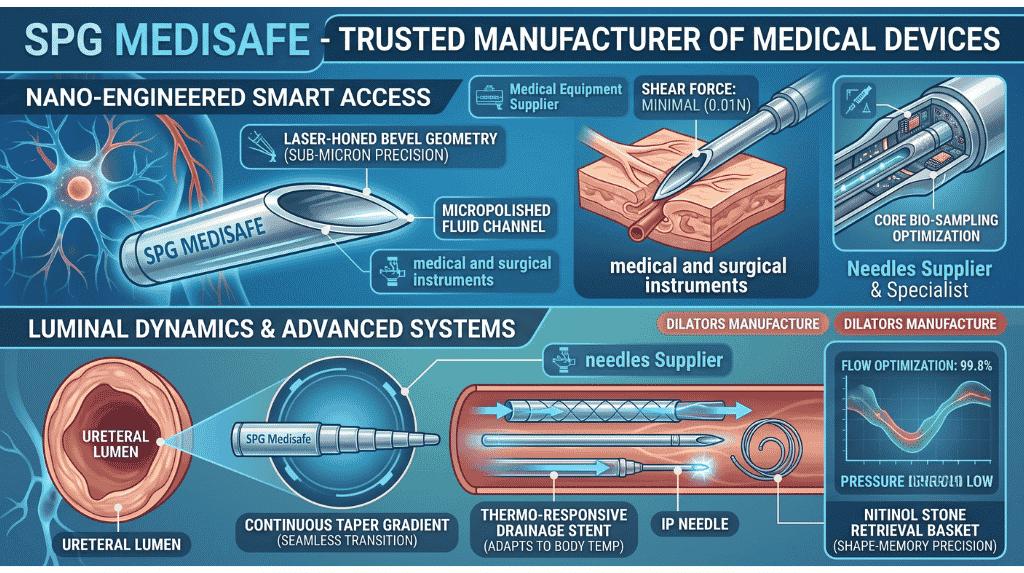
In high-stakes interventional specialties—such as Urology, Gastroenterology, and Interventional Radiology—the success of a procedure hinges entirely on the physical interface between the instrument and human anatomy. When navigating a tortuous ureter, passing through the biliary tree, or traversing dense tissue structures, standard medical consumables introduce subtle friction points. These micro-resistance vectors can translate into prolonged procedural times and localized patient trauma.
For modern healthcare systems, the core objective has shifted from simply securing medical hardware to acquiring instruments optimized for fluid dynamics and micro-structural behavior. As an established Medical Equipment Supplier and state-of-the-art Surgical Devices manufacture, SPG Medisafe is leading this shift. We look past traditional macro-molding to study the micro-architecture of medical and surgical instruments, engineering solutions that actively manage fluid friction and structural transition zones.
The Access Dilemma: Balancing Fluid Mechanics and Material Rigidity
Every percutaneous entry or luminal intervention demands a careful balance of conflicting material physics. An access device must maintain a rigid, kink-resistant core to withstand anatomical compressive forces, yet feature a highly elastic perimeter to conform seamlessly to natural curves. At SPG Medisafe, we resolve this access dilemma through targeted, specialty-specific product geometry.
1. The Physics of Shear Reduction: Needles Manufacture
Percutaneous access demands immediate structural stability without tearing adjacent tissue layers. Traditional mechanical grinding methods often leave micro-abrasions on steel surfaces, which creates microscopic tissue drag during insertion.
-
Laser-Calibrated Geometry: Our advanced needles manufacture protocols utilize synchronized multi-angle laser grinding to craft cutting edges with sub-micron precision. This allows our needles to split tissue cleanly, significantly reducing micro-bleeding.
-
Core Bio-Sampling Integrity: In complex diagnostics—such as using specialized core tissue systems—the internal fluid channels and cutting matrices are micro-polished down to the nanometer. This eliminates sample friction, ensuring clear, unfragmented biopsy yields on the very first pass.
By acting as a reliable, high-capacity needles Supplier, we ensure that diagnostic radiology and intervention suites maintain an uninterrupted inventory of premium access hardware.
2. Transition-Zone Calibration: Dilators Manufacture
Dilation requires expanding a narrow physiological pathway into a functional working channel. Sudden jumps in device diameter create distinct friction shelves that damage delicate mucosal linings.
-
Continuous Taper Extrusion: The machinery within our dilators manufacture division utilizes automated continuous extrusion to create long, uniform, incremental gradients on our access sheaths and dilatation systems. The physical transition from the guide wire lumen to the maximum outer diameter is completely seamless.
-
Radiopaque Matrix Fusion: To support accurate visualization under fluoroscopy, our medical-grade polymer matrices are infused with precise ratios of radiopaque compounds, ensuring distinct tip visibility during incremental advancement.
Serving as a specialized global dilators Supplier, we engineer our access tools to reduce manual insertion force, giving the operator enhanced tactile control.
Enhancing Luminal Performance: Advanced Catheters and Shape-Memory Systems
Beyond primary access, the ongoing performance of indwelling hardware depends on managing internal fluid dynamics and long-term bio-compatibility. Our core product lines focus directly on these operational requirements:
-
Thermo-Responsive Drainage Systems: Our specialized urological drainage systems and catheters are engineered from advanced bio-stable polymers that maintain ideal rigidity during initial deployment, then adapt slightly at core body temperature to match local anatomy—minimizing localized pressure points.
-
Nitinol Structural Manipulation: Our stone retrieval systems utilize shape-memory Nitinol alloys to deploy with predictable radial force within tight luminal spaces, allowing for the precise capture of calculi without requiring heavy, high-friction structural sheaths.
Why SPG Medisafe Stands as a Trusted Manufacturer of Medical Devices
Maintaining the role of a globally Trusted Manufacturer of Medical Devices requires an absolute commitment to standardized production, material transparency, and predictable supply chains.
1. Controlled Cleanroom Operations
Every consumable item in our portfolio is assembled, tested, and packaged within strictly monitored, certified cleanroom environments. By leveraging automated vision systems alongside our specialized research divisions, we inspect every batch for dimensional accuracy before it moves to validated Ethylene Oxide (ETO) sterilization cycles.
2. Resilient Global Supply Protocols
Operating under strict ISO 13485 quality management systems, SPG Medisafe provides complete batch traceability from initial material formulation to global delivery. We manage the entire pipeline from R&D and raw material forging to international distribution, helping healthcare networks eliminate supply chain bottlenecks for their core surgical consumables.
Conclusion: Engineering Clinical Assurance
From the fine point of an access needle to the internal lumen of a drainage catheter, the structural integrity of a consumable directly influences clinical outcomes. SPG Medisafe continues to elevate industry benchmarks by refining the microscopic details that protect patient anatomy and support the clinician’s skill.
Discover how precision-engineered fluid dynamics can optimize your clinical workflows.
Secure Your Clinical Supply: Connect with the SPG Medisafe team today to request a custom quote, review our technical product parameters, or discuss specialized OEM contract manufacturing partnerships.